La mayoría de las guías dietéticas europeas recomiendan sustituir los granos blancos y refinados por los enteros. Pero a veces puede resultar confuso identificar los productos integrales. ¿Cómo saber si mi pan, bagel, muffin inglés o barrita de granola son realmente de grano entero (integrales)?
Aquí tienes cinco criterios que te ayudarán a identificar los productos integrales y a reconocer aquellos que no lo son necesariamente.


No existen normas a nivel de la UE para el etiquetado de los productos de grano entero, pero algunos países han elaborado sus propias directrices para el etiquetado o declaraciones saludables de los alimentos elaborados con granos enteros.1
Si vives en uno de estos países, buscar un logotipo o una declaración de grano entero puede ser una forma sencilla de reconocer un producto integral. Más abajo encontrarás información sobre lo que significa en tu país. Si tu país no aparece en la lista, ¡pasa al consejo 2!
Dinamarca utiliza un logotipo voluntario para productos con granos enteros (integrales), que se muestra en aquellos con un mayor contenido de granos enteros (fuldkorn) y bajas cantidades de grasa, azúcar y sal. Para obtener este logotipo, un producto debe cumplir ciertos estándares en cuanto al contenido de granos enteros, mantener controlados los niveles de grasa, azúcar y sal, y alcanzar unos valores mínimos de fibra dietética. Por ejemplo, un producto puede llevar el logotipo si cumple con los siguientes criterios:
Dinamarca, Noruega y Suecia utilizan el logotipo nórdico voluntario Keyhole. Este pequeño símbolo que aparece en la parte frontal de los envases indica que el producto contiene más granos enteros y cumple otros criterios de alimentación saludable, como tener menos grasa, azúcar y sal, y más fibra en comparación con productos similares sin el símbolo. Para poder utilizar el símbolo Keyhole:


Ten en cuenta que los granos enteros son solo una pieza del puzle. También es importante prestar atención a factores como el azúcar, la sal y las calorías totales. En algunos países, incluso si un producto lleva una etiqueta o una declaración de “grano entero (integral)”, puede contener aún grandes cantidades de azúcar (más de 22,5 g por cada 100 g) o de sal (más de 1,5 g por cada 100 g), lo que puede tener efectos negativos para la salud.

Cuando revises las etiquetas de los productos, busca la palabra “integral” junto al nombre de un grano en la lista de ingredientes.
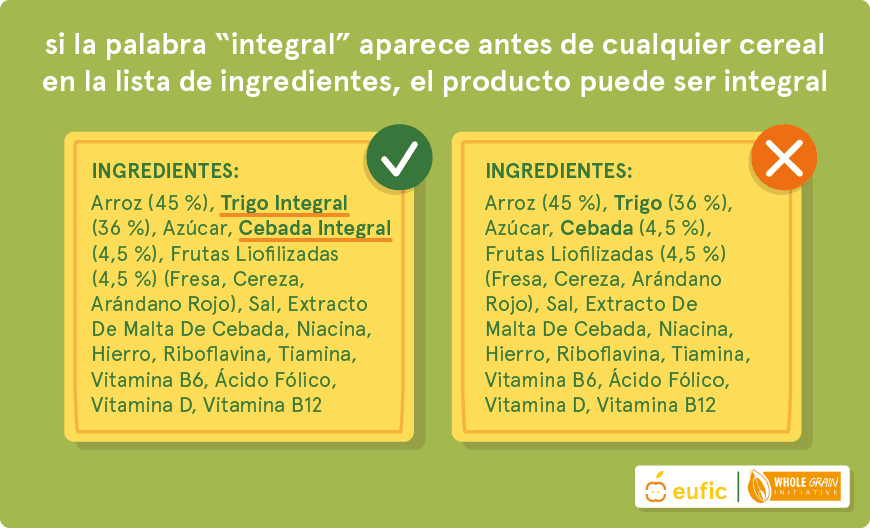
Sin embargo, con este criterio todavía es posible que elijas productos elaborados principalmente con granos refinados y solo una pequeña parte de granos integrales, ya que no tiene en cuenta la cantidad real de ese ingrediente en el producto. Recuerda que los ingredientes que están presentes en mayor cantidad aparecen al principio de la lista, mientras que los que se encuentran en menor cantidad aparecen hacia el final. Además, este criterio puede dejar fuera otras opciones integrales, ya que algunos granos, como el bulgur, no llevan la palabra “integral” en su nombre, aunque siempre sean opciones de grano entero.
Otro aviso: incluso si un producto cumple este criterio, podría seguir teniendo un alto contenido de azúcares, sal o calorías. Asegúrate de revisar la declaración nutricional y procura limitar los alimentos con más de 22,5 g de azúcares por cada 100 g o más de 1,5 g de sal por cada 100 g.

Para saber si un producto contiene granos enteros, revisa la lista de ingredientes en la etiqueta. Busca palabras como “integral” antes o después del nombre del cereal, por ejemplo, “pasta integral de trigo” o “avena integral”. Entre los ingredientes de grano entero también se incluyen la avena, el arroz integral, el amaranto, el trigo sarraceno, el bulgur, las palomitas de maíz y otros granos enteros.
Si los granos enteros aparecen como primer o segundo ingrediente (después del agua), por lo general puedes considerar que se trata de un alimento integral. Esto se debe a que los ingredientes se enumeran en orden decreciente según su peso: los que están en mayor cantidad aparecen al inicio de la lista, mientras que los que están en menor cantidad se sitúan al final.
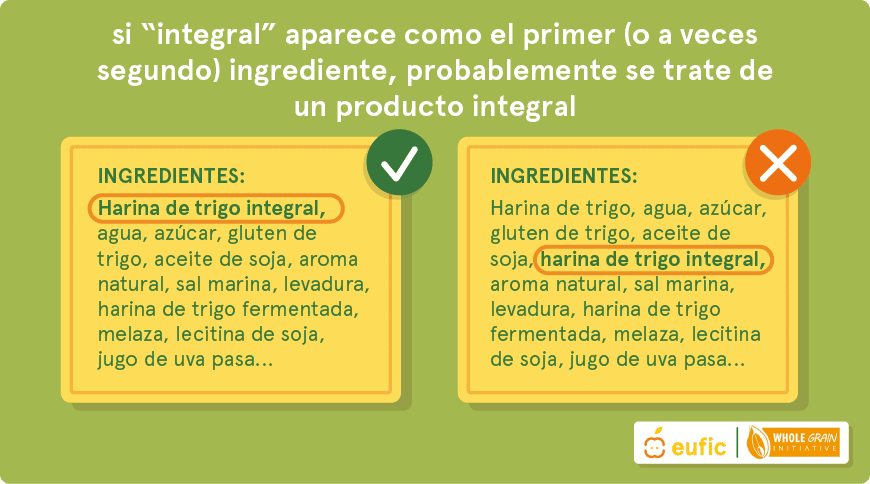
Aunque un producto cumpla este criterio, es posible que siga teniendo un alto contenido de azúcar y calorías. Asegúrate de revisar la información nutricional y procura limitar el consumo de productos con mucho azúcar (más de 22,5 g por cada 100 g).

Para saber si un producto es integral, revisa la lista de ingredientes en la etiqueta. Busca términos como “integral” antes o después del nombre del cereal, por ejemplo, “pasta integral de trigo” o “avena integral”. Entre los ingredientes de grano entero también se incluyen la avena, el arroz integral, el amaranto, el trigo sarraceno, el bulgur, las palomitas de maíz y otros granos enteros.
Si los granos enteros aparecen como primer o segundo ingrediente (después del agua) y los azúcares añadidos —como “azúcar”, “azúcar moreno”, “jarabe”, “concentrado de zumo de fruta” o “dextrosa”— no figuran entre los tres primeros ingredientes, por lo general puedes considerar que se trata de una opción integral más nutritiva. Esto se debe a que los ingredientes se enumeran en orden decreciente según su peso: los que están en mayor cantidad aparecen al inicio de la lista, mientras que los que están en menor cantidad se sitúan al final.
¿Por qué elegir productos con poco azúcar añadido? Porque es recomendable mantener la ingesta de azúcares añadidos y libres lo más baja posible: cuanto más azúcar consumimos, mayor es el riesgo de efectos negativos para la salud.
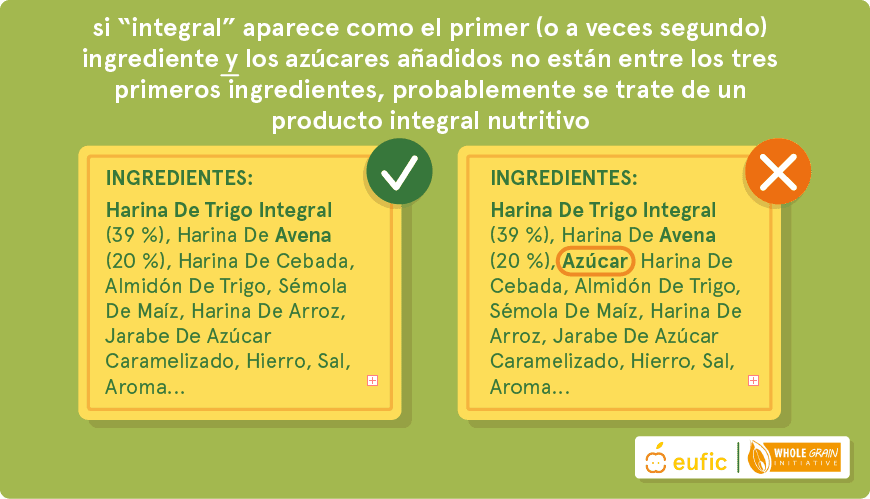
Aun así, ten cuidado. Algunos de estos productos pueden seguir teniendo un alto contenido de sal, así que revisa siempre la información nutricional. Procura limitar el consumo de alimentos con más de 1,5 g de sal por cada 100 g.

Veamos la información nutricional del alimento. Por cada 10 gramos de hidratos de carbono, debería haber al menos 1 gramo de fibra. Así, si un pan tiene 45 g de hidratos de carbono por cada 100 g, debería aportar al menos 4,5 g de fibra por cada 100 g.
Esta proporción 10:1 es una buena forma de identificar si un producto es integral, ya que es similar a la que se encuentra de forma natural en la harina de trigo integral. Los alimentos que cumplen este criterio suelen tener también menos azúcar, sal y calorías. En un estudio científico, esta proporción de 10:1 entre hidratos de carbono y fibra permitió identificar los productos integrales más saludables en comparación con otros criterios.5
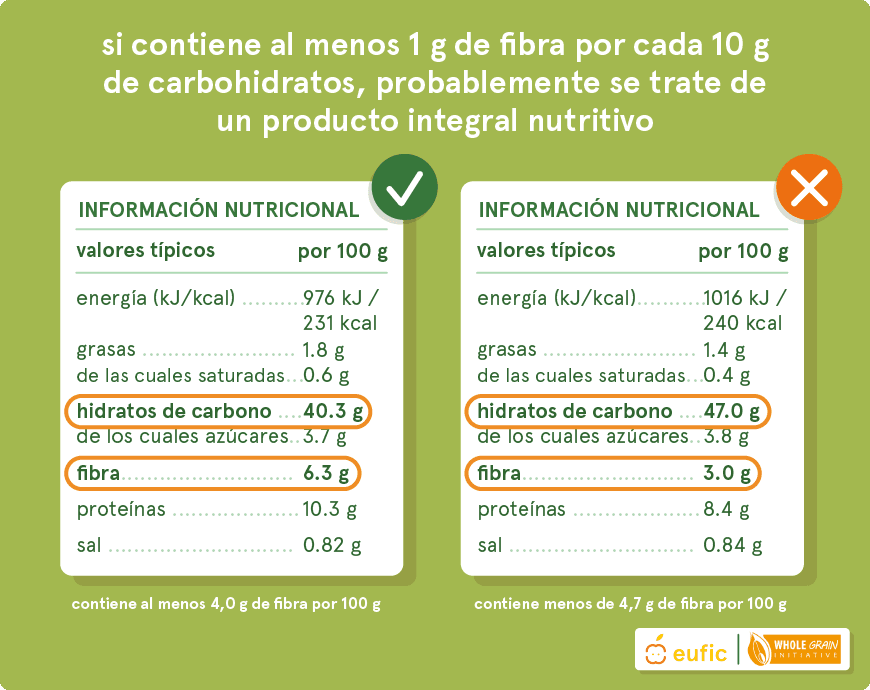
Aunque esta regla es fácil de aplicar y útil para identificar opciones integrales más nutritivas, no permite distinguir entre la fibra presente de forma natural en los productos integrales y la fibra que se añade por separado. Aunque tener más fibra (sea cual sea su origen) es mejor que no tener ninguna, la fibra añadida puede no aportar los mismos beneficios que la fibra que procede de los granos enteros y productos integrales. Además, un producto puede ser refinado y recibir fibra añadida posteriormente. La fibra añadida puede identificarse en la lista de ingredientes: suele aparecer como salvado, cáscara de psilio, inulina, raíz de achicoria, entre otros.
Cuando ves términos como “multigrano”, “molido a la piedra”, “100 % trigo”, “siete cereales”, “salvado” o “enriquecido” en los alimentos, no asumas que siempre son integrales. Esto es lo que realmente significan:
Por último, no te fíes del color. El pan oscuro puede deber su tono a ingredientes como la melaza o a colorantes, y no necesariamente a la presencia de granos enteros.
1.
Mathews, R., & Chu, Y. (2020). Global review of whole grain definitions and health claims. Nutrition Reviews, 78(Supplement_1), 98-106.
2.
Mozaffarian, R. S., Lee, R. M., Kennedy, M. A., Ludwig, D. S., Mozaffarian, D., & Gortmaker, S. L. (2013). Identifying whole grain foods: a comparison of different approaches for selecting more healthful whole grain products. Public health nutrition, 16(12), 2255-2264.
3.
NVWA. (2024). Volkorenproducten. Accessed 18 November 2024.
4.
Brood en Gezondheid. (2024). Volkoren definitie. Accessed 18 November 2024.
5.
Lebensmittel Klarnheit. (2023). Ist der Begriff „Vollkorn“ rechtlich gesuchützt? Accessed 18 November 2024.
Learn to identify whole grain products, cook delicious meals, find practical tips for a smooth, gradual switch, and much more!