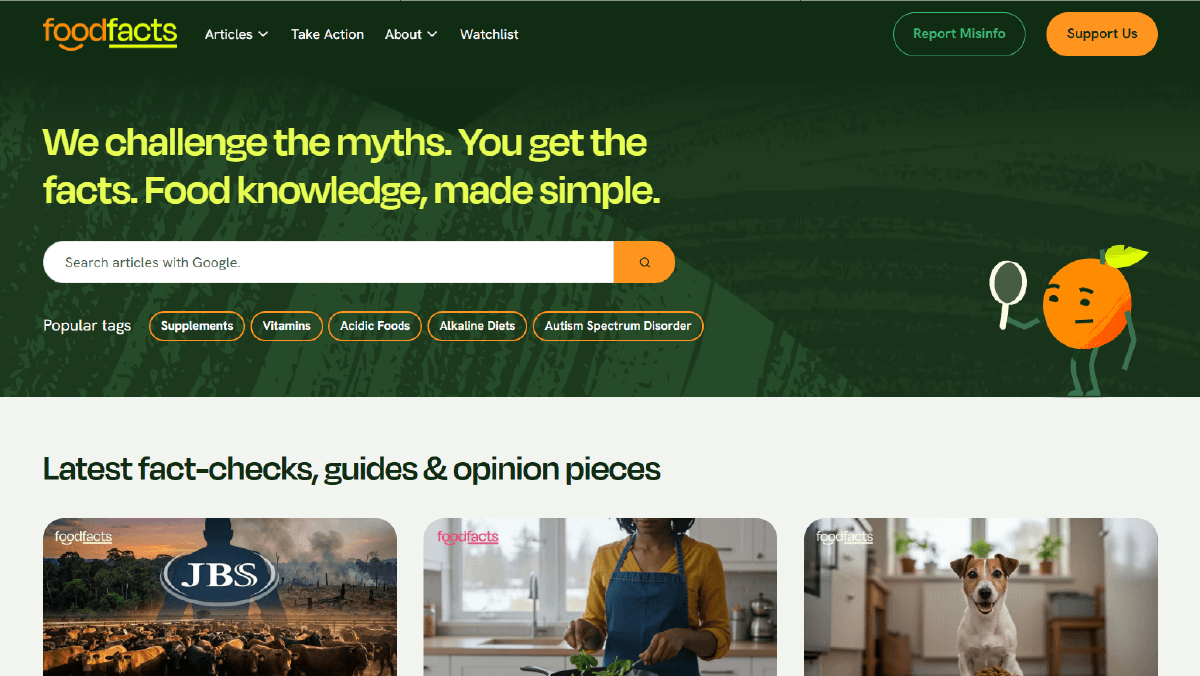
Cutting through diet misinformation is the work of a lifetime, and it’s why organisations like foodfacts.org exist: to make evidence clear, actionable, and humane for people navigating confusing claims about food and health. Whole grains are a prime example: their benefits are well-established, yet they’re often overshadowed by viral myths that discourage people from eating better.
Why misinformation spreads
Nutrition misinformation thrives in an “infodemic,” where too much content, much of it misleading, overwhelms people and amplifies confusion in fast-moving digital spaces. This noise erodes trust, nudges behaviour in unhelpful directions, and leaves people unsure whose advice to follow. In that fog, simple, sensational narratives outcompete careful, evidence-based guidance that takes nuance and context seriously.
Whole grains in the crossfire
Carb confusion and influencer soundbites can make whole grains seem risky or unnecessary despite consistent research linking regular intake with lower risk of cardiovascular disease, type 2 diabetes, and some cancers. Large pooled analyses suggest people eating more whole grains have meaningfully lower rates of all-cause and cardiovascular mortality compared with those eating little to none. The “why” isn’t magic; it’s the fibre, vitamins, minerals, and phytochemicals that remain when grains aren’t stripped and refined.
How misinformation blocks better eating
When every social media feed claims something different, many people default to inaction, oscillate between restrictive trends, or abandon nutritious staples like oats, brown rice, or whole wheat altogether. Chronic doubt also drains motivation: if “experts can’t agree,” it feels safer to stick with the familiar, even when the familiar undermines long-term health. Clear, consistent, and compassionate translation of evidence is therefore not a nice-to-have; it’s a public health necessity.
Building trust in food communication
Trust comes from transparent sourcing, acknowledging uncertainty, and avoiding absolutism, paired with practical steps people can apply today. It also means centering human experience: meeting readers where they are, respecting constraints, and focusing on improvements that compound over time rather than all-or-nothing perfection. Above all, trust grows when communicators show their work and keep commercial noise at arm’s length. Source: foodfacts
What drives us forward
As founder of foodfacts.org and the Freedom Food Alliance, the work is to lead a team that investigates food and nutrition claims, separates signal from noise, and delivers clear, science-backed explainers people can actually use. That means synthesizing rigorous evidence, challenging hype (respectfully), and publishing accessible guidance on everyday choices, from reading grain labels to making the swap from refined to whole. The commitment is simple: evidence first, empathy always, and no shortcuts in the pursuit of a food system people can trust.